Skokie Epoxy Flooring installs commercial epoxy flooring in Skokie, IL, serving surrounding cities including Lincolnwood, Winnetka, Norridge, Schiller Park and River Grove. After 20+ years on commercial slabs, we start every project with what the floor will face: the chemicals, the cleaning routine, the wheels, the temperatures and the hours the business cannot close.
Skokie’s commercial economy leans on retail and healthcare, with a hospital, medical offices and the lab and office buildings of the Illinois Science + Technology Park, alongside manufacturing employers and a delivery station on Howard Street. Each of those settings asks something different of a floor, and a single generic coating does not serve them all.
Our proposals name the product line, the number of coats and the finished thickness, and they explain why each layer was chosen. A facility manager can hold the finished floor against that document, and an inspector can see what went down.
Matching the System to the Room
Laboratories and Research Spaces
Lab floors see spilled solvents, acids and bases, and they are cleaned with strong disinfectants. We specify chemical-resistant epoxy or novolac epoxy systems based on the actual chemicals used in the room, often with an integral resin cove base to keep spills off the wall.
Seamless floors also make cleaning more reliable, since there are no grout lines or tile seams to hold contamination. Where the lab includes sensitive electronics, a static-dissipative system can be built into the same floor.
Clinics, Medical Offices and Healthcare
Hospital and clinic floors are mopped with hospital-grade disinfectants daily, and many standard coatings soften or dull under that routine. We use chemical-resistant topcoats that hold up to it and textures that provide grip without trapping dirt.
Healthcare jobs are planned around patient hours and infection-control requirements. We isolate work areas, capture grinding dust at the machine and schedule the work so clinical spaces reopen on time.
Retail, Showrooms and Offices
Retail floors need to look sharp while handling carts, pallet jacks and constant foot traffic. Flake, quartz and metallic epoxy systems offer durable, easy-to-clean surfaces in a range of looks, and a UV-stable polyaspartic topcoat keeps colors true near storefront windows.
Offices and lobbies can use solid color, flake or metallic systems that suit the brand. We also compare these with polished concrete, which can be the better long-term choice for large open floors.
Shops, Garages and Service Bays
Auto service bays and light manufacturing shops see oil, fuel, hydraulic fluid, hot tires and dropped tools. A high-build epoxy with a tough polyaspartic or urethane topcoat resists those exposures, and a broadcast finish adds grip where floors get wet or oily.
Warehouses and Delivery Floors
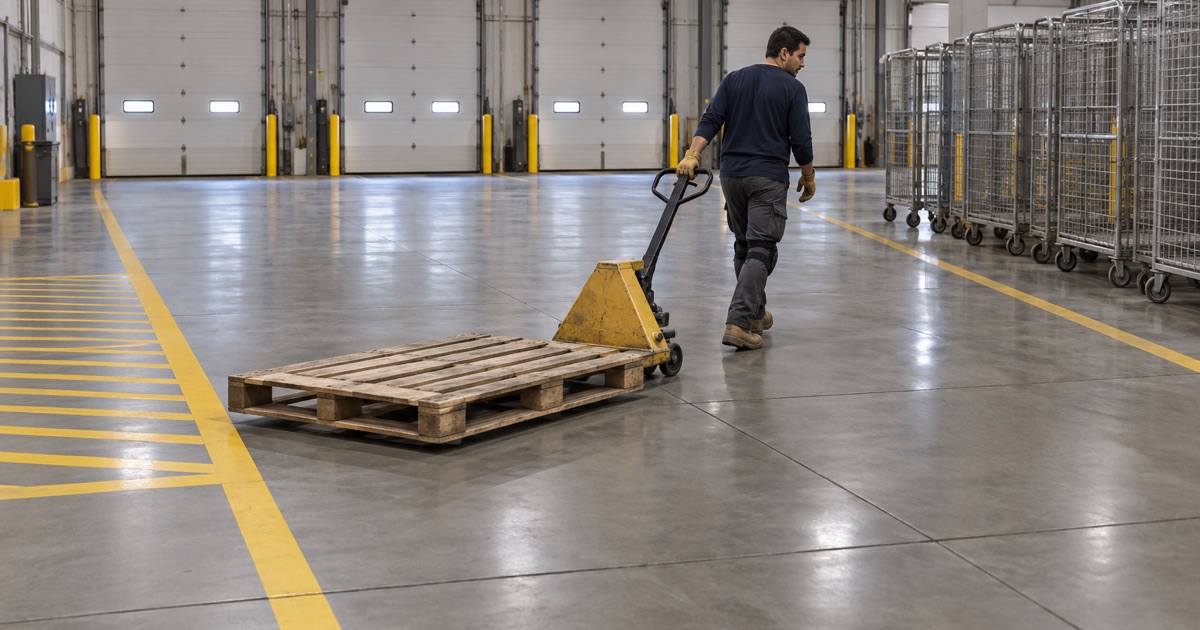
Warehouse aisles and delivery station floors carry forklift and pallet jack wheel loads all day, and those hard wheels grind through thin coatings and chip joint edges. We use high-build epoxy systems over shot-blasted concrete, with joints rebuilt and filled with a semi-rigid filler so wheels roll across rather than pounding the edges.
Traffic lanes, pedestrian walkways and loading zones can be marked in contrasting colors as part of the coating, so the safety striping is built into the floor rather than painted on top where it wears quickly.
Commercial Systems We Install
High-Build and Novolac Epoxy
High-build 100% solids epoxy is the workhorse of commercial floors, building thickness in fewer coats and resisting abrasion and many chemicals. Where concentrated acids or aggressive solvents are present, a novolac epoxy offers higher chemical resistance than standard bisphenol epoxies.
Both can be finished smooth for easy cleaning or with a broadcast aggregate for grip, and both can be topcoated with polyaspartic or urethane where UV exposure or abrasion is a concern.
Urethane Cement for Heat and Washdown
Where floors face hot water, steam cleaning, thermal shock or heavy washdown, urethane cement outperforms epoxy. It is the standard choice for commercial kitchens, food production and breweries, and it tolerates more slab moisture than most epoxies.
Quartz and Flake Broadcast Floors
Locker rooms, restrooms, break rooms and back-of-house areas often use quartz or vinyl flake broadcast systems. They add slip resistance and hide wear, and they can carry an integral cove base for easier cleaning at the wall.
Preparation on Commercial Slabs
Grinding and Shot Blasting
Commercial slabs are prepared with diamond grinding or shot blasting to a concrete surface profile that suits the system. Old coatings, tile adhesive and contaminants are removed so the new floor bonds to sound concrete. Grinding dust is captured at the machine with industrial vacuums, so it is not spread through an occupied building or washed toward a floor drain.
Moisture, Cracks and Joints
Every slab is tested for moisture before the price is final, because vapor from below is the leading cause of coating failure and the first exclusion in any warranty. Cracks and spalls are mapped and repaired, and joints are either filled or carried through the coating depending on whether they move. Where a slab is badly damaged or moisture readings are high, we explain the options, from a moisture-mitigation primer to slab repair, before anyone commits to a system.
Scheduling Around a Business
Phasing and Off-Hours Work
Labs, clinics, kitchens and shops often cannot close for days. We break the floor into phases, schedule grinding and coating overnight or on weekends, and use fast-curing products for areas that must reopen the next morning.
The phasing plan is part of the proposal, with dates, areas and cure times. That lets the business plan around the work rather than react to it.
Odor, Ventilation and Occupied Buildings
Resin coatings give off odors as they cure, which matters in buildings with occupants on other floors or in adjacent suites. We plan ventilation, choose low-odor products where needed and coordinate with building management on timing.
Compliance and Documentation
VOC Limits and Product Selection
Illinois sets VOC limits for floor and industrial maintenance coatings under 35 Ill. Adm. Code Part 223, alongside the federal rule at 40 CFR 59 Subpart D. Those limits bind the applicator, so we select compliant products for the Chicago ozone nonattainment area and keep product data sheets on file.
Inspections and Submittals
Some commercial floors are reviewed by the village’s building or health departments, or by state agencies for licensed facilities. We supply product data sheets and finish details for your submittal and build the floor to the approved specification.
- 20+ Years on Concrete
- Moisture Tested First
- Free Written Estimates