
Skokie Epoxy Flooring installs ESD flooring in Skokie, IL, serving surrounding cities including Lincolnwood, Winnetka, Norridge, Schiller Park and River Grove. Over 20+ years of resin floor work, we have learned that an electrostatic discharge floor is a measured system, not a color choice, and it has to be built, grounded and tested as one.
Static charge builds up as people walk and equipment moves, and a discharge that a person cannot even feel can damage sensitive electronic components. An ESD floor gives that charge a controlled path to ground, working together with footwear, grounded work surfaces and the rest of a facility’s ESD program.
We build static-dissipative and conductive epoxy floors for electronics assembly areas, labs, server rooms and other spaces where uncontrolled static is a risk. Each floor is tested after installation so its performance is documented rather than assumed.
How ESD Floors Work
Resistance Ranges
ESD floors are specified by their electrical resistance, measured in ohms. Conductive floors sit at the lower end of the range and drain charge quickly, while static-dissipative floors sit higher and drain charge in a slower, more controlled way.
The right range depends on what the facility handles and the standard its ESD program follows. We confirm the target range with you before choosing a system, since a floor that is too conductive or too resistive does not do its job.
Conductive Primers and Grounding
An ESD epoxy floor typically starts with a conductive primer and a grid of copper grounding tape or strips laid on the slab. Those connect to grounding points tied into the building’s ground, giving charge a continuous path off the floor.
The ESD topcoat contains conductive fibers or fillers that carry charge from the surface down to that conductive layer. The number and placement of grounding points are set by the floor area and layout.
Part of a Larger System
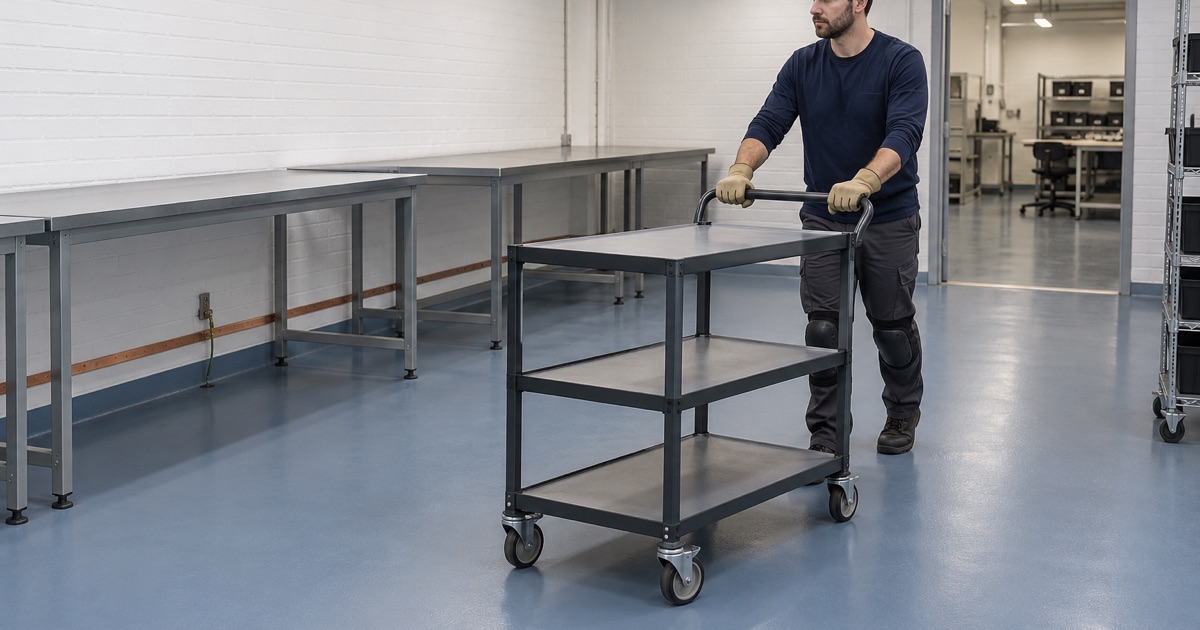
An ESD floor only protects anything when people wear ESD footwear or heel grounders and when carts and furniture have conductive casters. Workstations need their own grounded mats and wrist straps. We coordinate with your ESD coordinator so the floor fits the rest of the program, and we note the requirements for footwear and furniture in our handover.
Preparing the Slab
Grinding and Repairs
ESD systems are as sensitive to bond and slab condition as any epoxy floor. We grind the slab with diamond tooling to the required surface profile, remove old coatings and adhesives, and repair cracks and spalls before the conductive layers go down.
Cracks that move can break the continuity of the conductive layer, so they are treated with flexible fillers or carried through as joints. Dust is captured at the machine, which matters doubly in spaces near electronics.
Moisture Testing
Moisture coming up through a slab can affect both the bond and the electrical performance of an ESD floor. We test with ASTM F2170 relative humidity probes or ASTM F1869 calcium chloride kits before the price is final, and specify a moisture-mitigation primer where readings call for it.
ESD System Options
Static-Dissipative Epoxy
Static-dissipative epoxy is the most common choice for electronics work areas, labs and server rooms. It carries charge away in a controlled way, offers a seamless, cleanable surface, and can be supplied in a range of colors to mark work zones.
The system typically includes a primer, a conductive layer with grounding strips, and a dissipative topcoat. Total thickness and build are set by the manufacturer’s system and are stated on our proposal.
Conductive Epoxy
Conductive epoxy floors have lower resistance and are used where charge must drain very quickly, such as in some handling areas for sensitive components. They require careful attention to grounding and footwear, since the low resistance changes how the floor interacts with people and equipment. We help you decide between conductive and dissipative ranges by reviewing what is handled in the space and what your ESD program calls for.
Phasing in a Working Facility
Electronics and data spaces often cannot shut down for long. We phase the work by area, protect equipment from dust, and schedule grinding and coating for nights or weekends where needed. Because grounding connections and testing must be completed before the floor goes back into service, each phase includes time for resistance checks before equipment and staff return.
Where ESD Flooring Is Used
Electronics Assembly and Repair
Circuit board assembly, repair benches and component storage all need static control. ESD floors let workers move around freely while staying grounded through their footwear, rather than relying only on wrist straps at the bench.
Server Rooms and Data Spaces
Server rooms and network closets benefit from floors that reduce static buildup as staff move equipment and cables. A static-dissipative epoxy floor also seals the concrete, reducing dust that can clog cooling equipment.
Labs and Clean Areas
Laboratories that handle sensitive instruments, along with some pharmaceutical and research spaces, use ESD floors to protect equipment and processes. In those spaces, the floor also needs to resist the chemicals and cleaners used daily, so we select systems that meet both needs.
Testing, Documentation and Care
Post-Installation Testing
Once the floor has cured, we measure resistance point-to-point and point-to-ground across the floor with a calibrated meter. The readings are recorded and given to you as a baseline for your ESD program and future audits.
If a reading falls outside the target range, we investigate and correct it before handover. A floor is not complete until it tests where it was specified.
Cleaning Without Insulating the Floor
Waxes, polishes and some cleaners leave an insulating film that blocks the floor’s ability to dissipate charge. We provide cleaning guidance and recommend ESD-safe products so the floor keeps performing. Regular resistance testing, often as part of a facility’s ESD audits, confirms the floor remains within range over time.
Products Within Illinois VOC Limits
Illinois limits volatile organic compounds in floor and industrial maintenance coatings, and those limits bind the person applying the coating. We select ESD primers and topcoats that comply in the Chicago ozone nonattainment area and list the exact products, coats and finished thickness on the proposal, so the floor can be checked against the quote and your facility records.
- 20+ Years on Concrete
- Moisture Tested First
- Free Written Estimates